
How To Choose Fresh Fish
Choosing fresh fish is a skill — and once you know what to look for, you’ll never be fooled by a tired fish again. Freshness is the single biggest factor in how good your fish tastes, how well it cooks, and how safe it is to eat. Yet most people have never been shown the simple, reliable checks that fishmongers use every day.
This is that guide. We’ll show you exactly how to tell if fish is fresh — the seven signs to look for, the mistakes to avoid, how fresh compares to frozen, and how we choose fish by hand at Billingsgate Market every week. Read it once and you’ll buy fish with confidence for the rest of your life.
Start here
Why Freshness Matters
Before the how, the why. Freshness isn’t a luxury or a marketing word — it changes everything about the fish on your plate, from flavour to safety.
Taste
Freshness is flavour. A fish eaten close to the day it was caught has a clean, sweet, almost mineral taste of the sea. As fish ages, that delicate flavour fades and turns dull — no amount of seasoning brings it back.
Texture
Truly fresh fish has firm, springy flesh that holds together and gives a satisfying bite. Older fish goes soft and mushy as its proteins break down, falling apart in the pan and losing that prized texture.
Nutrition
Fish is at its nutritional best when fresh, retaining its full complement of omega-3 fatty acids, protein and delicate vitamins. The fresher it is when it reaches you, the more of that goodness survives to your plate.
Food safety
Freshness and safety go hand in hand. Fish that has been kept properly cold and eaten promptly is far safer than fish that has been sitting too long or stored badly, where spoilage bacteria multiply quickly.
Cooking performance
Fresh fish simply behaves better. The skin crisps, the flesh stays moist and intact, and it takes on heat evenly. Tired fish weeps water, sticks, breaks apart and disappoints however carefully you cook it.
Why fresh costs more
Genuinely fresh fish costs more because it is bought in smaller quantities, handled quickly, kept cold through a short supply chain and sold fast — not mass-bought and stored for days. You are paying for quality and speed, and it shows.
The fishmonger’s checklist
The 7 Signs Of Fresh Fish
These are the exact checks we make at the market every Saturday. Learn them and you can judge any fish, anywhere, in seconds.
Bright, clear eyes
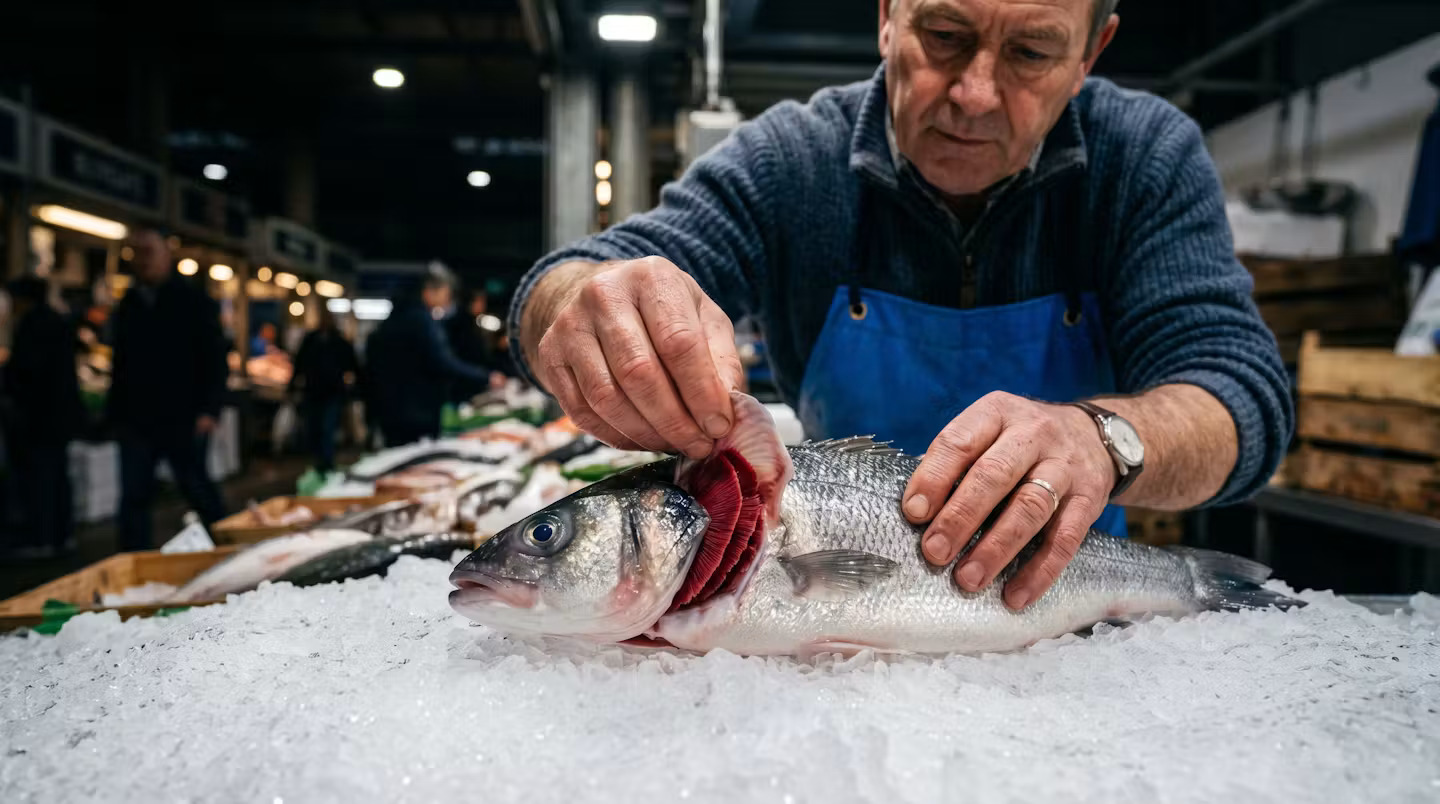
The eyes are the quickest tell. Fresh fish has plump, bright, clear, slightly bulging eyes with a black pupil and translucent cornea. As fish ages the eyes turn cloudy, grey, sunken and dull. Cloudy, collapsed eyes are a clear sign to walk away.
Bright red gills
Lift the gill cover and look underneath. Fresh gills are a vivid, clean red or deep pink and moist. As the fish deteriorates they fade to dull brown, grey or pale pink and can become slimy. Bright red gills are one of the most reliable freshness signs.
Shiny, metallic skin
Fresh fish has bright, shiny, almost metallic skin with its natural slime sitting clear and thin. The colours are vivid and the markings sharp. Dull, faded skin with thick, sticky or yellowing slime means the fish is past its best.
A clean sea smell
Fresh fish smells of the sea — clean, briny, like a fresh ocean breeze or cucumber. It should never smell strongly “fishy”, sour, or of ammonia. A sharp, unpleasant or ammonia-like smell is the single biggest warning sign.
Firm, springy flesh
Press the flesh gently with a finger. On a fresh fish it springs straight back and leaves no mark. If your finger leaves a dent that stays, the flesh has started to break down and the fish is no longer fresh.
Tight, intact scales
Fresh fish has scales that are firmly attached, intact and shiny, with skin that’s taut over the body. Scales that are missing in patches, lifting or come away at a touch suggest the fish has been handled a lot or is ageing.
Properly cold
Fresh fish should be cold to the touch, kept on or under ice, or properly chilled throughout. Fish sitting at room temperature, or in a warm display, spoils rapidly — temperature is just as important as how the fish looks.
Fresh vs past its best
Spot The Difference
A simple side-by-side. If you see the signs on the left, buy with confidence; if you see the signs on the right, walk away.
Signs of fresh fish
- Bright, clear, bulging eyes
- Vivid red, moist gills
- Shiny skin with thin, clear slime
- A clean, fresh sea smell
- Firm flesh that springs back
- Tight, intact scales
- Kept cold, on or under ice
Warning signs to avoid
- Cloudy, grey or sunken eyes
- Dull brown, grey or slimy gills
- Faded skin with thick, sticky slime
- A strong fishy, sour or ammonia smell
- Soft flesh that holds a dent
- Loose or missing scales
- Sitting warm or unrefrigerated
Don’t get caught out
Common Mistakes Buyers Make
Even careful shoppers fall for these. Knowing them is half the battle.
Ignoring the eyes
Cloudy, grey or sunken eyes are the clearest sign of an old fish — yet they’re the first thing people overlook. Always check the eyes first.
Excusing a strong smell
“Fish just smells fishy” is a myth. Genuinely fresh fish smells of the sea, not pungent. A sharp, sour or ammonia smell means it’s past its best — don’t talk yourself into it.
Not testing the flesh
Soft flesh that holds a dent has started to break down. A two-second press tells you what your eyes might miss.
Poor storage at home
Even perfect fish spoils fast if it’s left warm. Get it cold quickly, keep it on the coldest shelf, and cook it within a day or two.
Buying from the wrong place
A fast-moving specialist with a short supply chain will almost always beat a slow, high-volume counter. Where you buy matters as much as what you buy.
Choosing on price alone
The cheapest fish is rarely the freshest. A little more for hand-selected, properly handled fish pays off in flavour, texture and far less waste.
A balanced view
Fresh vs Frozen
Fresh isn’t automatically better than frozen — it depends on the fish and the supply chain. Here’s the honest comparison.
When fresh wins
Fresh fish is unbeatable when the supply chain is short and fast and you’ll cook it soon. The texture is firmer, the flavour cleaner, and the skin crisps better — especially for whole fish you want to grill, roast or pan-fry. This is exactly where hand-selected, market-fresh fish shines.
If you can buy fish that was at the market that week and cook it within a day or two, fresh is the finest you can eat.
When frozen makes sense
Frozen fish has real strengths and shouldn’t be dismissed. Fish frozen quickly at sea can be superb — sometimes fresher than “fresh” fish that has travelled for days — because freezing locks in quality the moment it’s caught. It’s also convenient, reduces waste, and lets you keep fish on hand.
The key is how, and how quickly, it was frozen. Well-handled frozen fish, defrosted gently in the fridge, is a genuinely good choice.
The honest answer: the freshest, best-handled option wins — whether that’s fish hand-picked at the market this week, or fish frozen properly at sea. What you’re really judging is freshness and handling, not the label.
Our standard
How House O Fish Selects Fish
We don’t ask you to take freshness on trust — we earn it the hard way, by hand, every week. Here’s exactly how.
We arrive before dawn
Every Saturday morning, while most of London is still asleep, we’re on the floor at Billingsgate Market in the early hours. The earliest buyers get the pick of the catch, so being there first is the whole point.
We inspect every fish by hand
We don’t buy from a list or a screen. We check fish individually using exactly the signs in this guide — clear eyes, red gills, firm flesh, shiny skin, a clean sea smell. Nothing is bought blind.
We reject anything below standard
If a fish doesn’t meet our standard that morning, we don’t buy it — simple as that. We’d rather offer less and have it be excellent than fill an order with fish we wouldn’t cook ourselves.
We prepare to order
Back from the market, we clean, scale, gut and fillet your fish exactly as you’ve asked, so it arrives ready to cook. Whole fish are prepared with care to keep them in peak condition.
We deliver chilled
Your order is cold-packed to hold it at its best and delivered chilled across London the same week — so the fish that passed our inspection at dawn is the fish that reaches your kitchen.
It’s the same approach a careful home cook would take, done for you every week. See it for yourself Behind The Catch, learn more About House O Fish, or read how we handle Billingsgate fish delivery across London.
Save it · print it
Your Fresh Fish Buying Checklist
Take this with you, or keep it on your phone. Run through it whenever you buy fish — if it passes, you’re holding a fresh one.
Fresh Fish Checklist
Tick each one. The more it passes, the fresher the fish.
Everything you asked
Fresh Fish FAQ
Look for bright, clear eyes, vivid red gills, shiny skin, firm flesh that springs back, tight scales and a clean sea smell — and make sure it’s been kept properly cold. If several of these signs are off, especially cloudy eyes or a strong fishy smell, the fish isn’t fresh.
Fresh fish is best eaten within one to two days of purchase, kept on the coldest shelf of the fridge. The sooner you cook it, the better it tastes. If you can’t use it in that window, freeze it on the day you receive it.
Only of the sea. Fresh fish has a clean, briny, almost cucumber-like smell. It should never smell strongly “fishy”, sour or of ammonia — those smells mean the fish is past its best and should be avoided.
Yes. Freeze it on the day you buy it for the best results, wrapped well to prevent freezer burn, and defrost it gently in the fridge before cooking. Never re-freeze fish that has already been defrosted.
The eyes are one of the fastest, most reliable freshness checks. Fresh fish has bright, clear, slightly bulging eyes; as it ages the eyes turn cloudy, grey and sunken. Cloudy, collapsed eyes are a clear sign the fish is old.
As cold as possible without freezing — ideally around 0–2°C, on ice or on the coldest shelf of your fridge. Fish kept at warmer temperatures spoils quickly, so get it into the fridge as soon as you’re home.
By eye, touch and smell — exactly the signs in this guide. We check the eyes, lift the gills to see the colour, press the flesh for firmness, look at the skin and slime, and smell for that clean sea scent. It’s a skill built on handling fish every week.
Whole fish lets you judge freshness more easily, because you can check the eyes, gills, skin and scales — clues a fillet doesn’t show. Whole fish also keeps slightly better, as the skin and bones protect the flesh. With fillets, rely on firmness, colour, a clean smell and a fishmonger you trust.
Firm and springy. When you press it gently, fresh flesh bounces straight back and leaves no dent. Soft flesh that holds the mark of your finger has begun to break down and is no longer fresh.
Gills are where deterioration shows early. Fresh gills are clean, bright red or deep pink and moist; as the fish ages they fade to brown or grey and turn slimy. Checking the gills is one of the surest ways to judge a whole fish.
Not always. Fish frozen quickly at sea can be excellent — sometimes fresher than “fresh” fish that has travelled for days. Fresh is ideal when you have a short, well-handled supply chain and will cook it soon; good frozen fish is a genuine, convenient alternative.
Ideally within one to two days. Fish is at its peak the day it’s bought, so the sooner you cook it the better. If you need longer, freeze it on the day rather than leaving it in the fridge.
A strong fishy, sour or ammonia smell is a sign the fish has spoiled and it’s best not to eat it. Truly fresh fish smells clean and of the sea, not pungent. When in doubt, throw it out — it isn’t worth the risk.
From a specialist fishmonger with a short, fast supply chain — ideally one who hand-selects at a market like Billingsgate. House O Fish buys fresh at Billingsgate every Saturday and delivers across London, so the fish reaches you quickly and in peak condition.
Unwrap it, pat it dry, place it on a plate or in a container on the coldest shelf of the fridge, and ideally sit it on or over ice. Keep it covered, away from other foods, and cook within a day or two.
Because genuine freshness costs more to deliver: smaller quantities, hand selection, careful handling, a short cold supply chain and quick turnover. You’re paying for quality and speed rather than bulk — and the difference in taste and texture is real.
Buy with confidence
Let Us Choose The Freshest Fish For You
Now you know what to look for — and it’s exactly what we do at Billingsgate Market every Saturday morning. Hand-selected, inspected, prepared to order and delivered chilled across London. Join our WhatsApp community to see this week’s catch and order with total confidence.
Explore more: Billingsgate Fish Delivery London · Online Fish Shop London · How to Cook Whole Sea Bass · Best Fish for BBQ · Fresh Anchovies · Fresh Sardines · Fresh Turbot